This is a sneak peek of this week’s Deep Dives article. Published today!
Some people have mastered the language of emotional intelligence. They know how to listen, validate feelings, apologize gracefully, and say precisely what others need to hear. But does their behavior change when the conversation ends? This Deep Dive explores the uncomfortable difference between sounding emotionally intelligent and actually being sincere, why empathy without accountability can become manipulation, and why genuine sincerity is ultimately measured by what people do when their words are no longer enough.
This is a sneak peek of this week’s Deep Dives article. Published today!
Avoidance offers one of life's most seductive bargains: immediate relief in exchange for consequences we convince ourselves we can deal with later. The difficult conversation, the uncomfortable decision, the relationship we refuse to examine, or the problem we hope will disappear rarely stays conveniently on hold. This Deep Dive examines how avoidance quietly reshapes our choices, limits our freedom, and turns manageable problems into much larger ones. Sometimes the greatest obstacle to moving forward is the truth we already know but keep finding reasons not to confront.
This is a sneak peek of this week’s Deep Dives article. Published today!
How many capable people spend their careers waiting for someone to recognize their potential, give them authority, or invite them to take responsibility? Leadership does not necessarily begin with a promotion, a title, or an organizational announcement. More often, it begins when someone sees a problem and decides to do something constructive about it. This Deep Dive challenges the permission trap, explores why intelligent people hesitate to step forward, and examines how organizations inadvertently discourage the very initiative they claim to value. The most compelling evidence that someone is ready to lead may be that they have already started.
This is a sneak peek of this week's Deep Dives Book Review. Published today!
What if the greatest threat artificial intelligence poses to your business is not the technology itself, but your organization's inability to adapt quickly enough to use it? In Future Proof: Transform Your Business with AI (or Get Left Behind), Dr. Michael Gene Housman challenges leaders to move beyond AI experimentation and start treating it as a fundamental business transformation opportunity. This Deep Dive explores his practical five-stage framework for identifying high-value opportunities, generating measurable returns, overcoming organizational resistance, and building a culture capable of continuous innovation. More importantly, it examines why the real competitive advantage may not belong to companies with the most sophisticated AI, but to those with the leadership, judgment, and discipline to put it to work.
The Trust Gap: Why Smart Teams Still Miscommunicate
I have spent much of my professional life working with intelligent, experienced people who are perfectly capable of understanding complex problems. They can analyze data, develop strategies, manage substantial budgets, and articulate sophisticated arguments about where a business needs to go. Yet put six of them in the same meeting, discuss an important decision, and there is a reasonable chance that at least three will leave with different interpretations of what was agreed.
It is tempting to call this a communication problem. Sometimes it is. But increasingly, I think we underestimate the extent to which miscommunication is actually a trust problem.
People hear words through the filter of their experiences, assumptions, anxieties, and perceptions of the person speaking.
The result is that two perfectly intelligent people can hear exactly the same message and walk away with entirely different understandings.
Intelligence Does Not Guarantee Shared Understanding
We tend to assume that intelligent teams should communicate more effectively.
But intelligence can complicate communication as easily as improve it.
Intelligent people are often exceptionally good at constructing explanations for what they believe someone meant. Unfortunately, they can also become remarkably confident in interpretations they have never bothered to verify.
Consider a leader who tells the team that improving revenue performance is now the organization's highest priority. Marketing hears a directive to accelerate campaigns. Sales interprets it as pressure to improve conversion. Finance assumes spending discipline must become more aggressive. Operations worries that service quality is about to be sacrificed.
Everyone believes they understood the message.
The problem becomes visible several weeks later when the individual initiatives collide.
The original ambiguity has become an organizational conflict.
Trust Changes What People Are Willing to Hear
When trust is high, ambiguity tends to invite clarification.
When trust is low, the same ambiguity produces a very different response. People become cautious. They listen for hidden intentions, anticipate criticism, and try to identify the interpretation least likely to create trouble.
If employees believe that asking for clarification makes them look incompetent, they will guess. If challenging an instruction risks being labeled difficult, they will comply while privately disagreeing.
The organization may become quieter, but it will not become better informed.
The Leader's Behavior Changes the Meaning of the Message
One of the less comfortable realities of leadership is that people rarely listen only to what the leader says. They also remember how the leader behaved the last time something went wrong.
This is where leaders can unintentionally manufacture the very communication problems they complain about.
They ask for ownership but repeatedly override decisions. They encourage candor but react poorly to disagreement. Eventually, employees begin spending as much mental energy interpreting the leader as they spend understanding the work.
Clarity Requires More Than Saying Something Clearly
Leaders frequently confuse having communicated with having established understanding.
From the leader's perspective, communication has occurred. From the team's perspective, interpretation has only just begun.
Real clarity requires checking whether people understand the decision in the same way, particularly when different departments have different responsibilities or incentives.
More Communication Can Make Things Worse
Technology has made communication almost frictionless.
Yet more communication has not necessarily produced more understanding.
Organizations can now distribute confusion more efficiently than ever before.
Technology is enormously useful for preserving information and improving access to it. But no communication platform can repair a relationship in which people are afraid to question what they have been told.
Closing the Trust Gap
Leaders must create conditions in which disagreement, clarification, and inconvenient information are welcomed without sacrificing accountability.
Teams, meanwhile, need to accept responsibility for verifying understanding rather than assuming it. One practical habit is to conclude important discussions by having the responsible individuals explain, in their own words, what they believe was decided, what they own, and what will happen next.
The Conversation Beneath the Conversation
When people trust one another, they spend less energy protecting themselves from the conversation and more energy making the conversation useful.
Smart people will always misunderstand one another occasionally. Human communication is too complicated for anything else.
The leadership challenge is to build an environment where those misunderstandings are discovered early, discussed openly, and corrected without turning every clarification into a referendum on competence, loyalty, or authority.
Because the greatest communication risk is not that people misunderstand what was said.
It is that they no longer feel safe enough to find out.
QUICK READ — PERSONAL DEVELOPMENT
The Addiction to Chaos: Why Some People Cannot Function Without Drama
I have known people who seem to move from one crisis to another with astonishing consistency. There is always a disagreement, an emergency, a misunderstanding, a betrayal, a new enemy, or some extraordinary situation requiring immediate attention.
What fascinates me is that these people are not necessarily unhappy with the arrangement, at least not consciously. They complain about the drama, resent the people involved, and insist that all they want is a little peace. Yet their behavior repeatedly recreates the very conditions they claim to despise.
The uncomfortable possibility is that people can become attached to emotional conditions that are demonstrably bad for them, simply because those conditions have become central to how they understand themselves.
When Chaos Becomes Familiar
Human beings are creatures of familiarity, even when what is familiar is unpleasant.
Someone raised in an unpredictable environment may become exceptionally good at detecting changes in mood, anticipating conflict, managing volatile personalities, and recognizing potential threats.
The problem emerges when those adaptations continue operating long after the original circumstances have changed.
Sometimes people mistake emotional intensity for connection because intensity has always accompanied their most significant relationships. When that intensity disappears, they interpret the absence as evidence that something is missing.
What may actually be missing is the turbulence.
Drama Provides Something
If a behavior continues despite its obvious disadvantages, I think it is worth asking what the person is getting from it.
Drama can provide attention. It can create a sense of importance. It can make someone feel indispensable because they are always managing the latest emergency.
Consider the person whose life is permanently consumed by other people's problems. They are constantly rescuing, mediating, advising, confronting, and repairing. Their exhaustion is real, but so is the identity they have constructed around being needed.
What happens when nobody needs rescuing?
For some, that question is surprisingly threatening. Without the crisis, they must confront an uncomfortable uncertainty about who they are when they are not necessary to everyone else's survival.
The Difference Between Processing and Rehearsing
There is a point at which talking about a problem stops helping us understand it and starts helping us preserve it.
Not every conversation about a problem is an attempt to solve it. Sometimes it is an attempt to keep feeling it.
The Drama of Being Right
Another source of recurring chaos is the inability to tolerate being misunderstood, challenged, disappointed, or contradicted.
Some people interpret ordinary differences of opinion as personal attacks. A delayed response becomes rejection. A disagreement becomes disrespect. A boundary becomes betrayal.
Emotional intelligence requires recognizing that feelings are important sources of information, but they are not automatically reliable judgments about someone else's intentions.
Chaos in Leadership
This pattern becomes particularly destructive when the person at the center of it holds authority.
I have worked around leaders who seem almost energized by emergencies. They intervene dramatically, redirect priorities, demand immediate responses, and create a sense that everything is exceptionally urgent.
Once the crisis passes, the leader feels productive.
Meanwhile, the team is exhausted.
An organization should not have to become unstable for its leader to feel effective.
Learning to Live Without the Noise
Breaking an attachment to chaos requires something more demanding than simply deciding to avoid dramatic people.
It requires examining the emotional rewards hidden within the pattern.
What do I gain from being involved in every conflict? Why does a quiet period make me restless? Do I confuse being needed with being valued?
These are difficult questions because they remove the comfort of believing that all the drama is happening to us.
When Peace Finally Feels Normal
Perhaps the strangest thing about a life organized around drama is how much genuine living it can displace.
I think genuine emotional maturity involves learning that peace does not have to be earned through exhaustion. Stability does not have to be suspicious. Relationships do not need recurring conflict to prove their depth. And a person does not need to be at the center of an emergency to matter.
The challenge for someone accustomed to chaos is not merely learning how to avoid drama. It is developing a life, and a sense of self, sufficiently meaningful that drama no longer needs to fill the empty spaces.
Sometimes the greatest evidence of emotional growth is not how well we handle the next crisis, but how comfortable we have become when there isn't one.
QUICK READ — LEADERSHIP
The Leadership Advantage Nobody Can Fake: Authenticity
There is something rather revealing about the amount of effort organizations now devote to making their leaders appear authentic. Executives are coached to sound more human.
We have become remarkably sophisticated at manufacturing the appearance of authenticity.
And therein lies the contradiction.
Authenticity has become a leadership attribute that people are encouraged to demonstrate, sometimes with considerable rehearsal. Yet the moment authenticity becomes primarily about how we want others to perceive us, we are already drifting away from what makes it valuable.
I suspect most employees are considerably better at recognizing this distinction than their leaders realize. They may appreciate an inspiring speech, a personal anecdote, or an unusually candid town hall. But their judgment of a leader's authenticity is formed elsewhere, usually during moments that receive far less attention.
Authenticity can be performed convincingly for a meeting. It is much harder to sustain the performance across a thousand decisions.
The Difference Between Personality and Character
One of the most common misconceptions about authentic leadership is that it requires people to become more personally expressive.
I have known reserved, understated leaders who were deeply authentic. They rarely discussed their personal lives, showed little interest in inspiring speeches, and would probably have been uncomfortable being described as charismatic. Yet people trusted them because their behavior was consistent. Their words meant something, their standards were clear, and their decisions reflected principles that did not change depending on who was watching.
Conversely, I have encountered wonderfully engaging personalities whose warmth disappeared the moment accountability became uncomfortable.
The distinction matters because personality can create an immediate impression, while character is revealed through accumulated experience.
Authenticity belongs much more firmly in the second category.
People Remember What Happens Under Pressure
Most leaders can appear authentic when circumstances are favorable.
Pressure introduces a more meaningful examination.
The important question is whether their stated principles continue to govern their behavior when those principles become personally inconvenient.
Employees learn quickly whether accountability is a shared obligation or something leadership administers to everyone else.
Authenticity Requires Self-Awareness, Not Self-Indulgence
Being authentic does not give leaders permission to behave however they please.
I have heard people defend impatience, bluntness, emotional volatility, and occasionally outright rudeness by explaining that they are simply being themselves.
Fair enough. Those characteristics may be genuine. But authenticity cannot become a permanent exemption from personal growth.
Self-awareness becomes useful only when it influences behavior.
Being yourself is not a leadership virtue if you are unwilling to take responsibility for the effect of being yourself on everyone else.
The Organization Knows the Difference
The company may describe itself as transparent, collaborative, and accountable. Its employees, meanwhile, know which subjects are unsafe to discuss, which executives cannot be challenged, and which standards become flexible when the right person is involved.
This creates a credibility problem that no internal communications campaign can solve. Leaders may continue saying the right things, but their words progressively lose influence because people have learned to judge the message against the evidence.
Authenticity Is Also the Willingness to Change
There is a subtle trap in believing authenticity means remaining consistent with the person we have always been.
In fact, I would argue that the willingness to change is one of the more persuasive signs of authentic leadership. It demonstrates that the leader's commitment to truth is greater than their attachment to appearing right.
The Advantage That Compounds
There is a practical advantage to authentic leadership that receives surprisingly little attention: it reduces the amount of organizational energy spent managing perception.
It is also difficult for competitors to replicate. Strategies can be copied, technology purchased, compensation packages matched, and operating processes adopted. But the accumulated credibility of a leader who has consistently demonstrated integrity, fairness, humility, and sound judgment cannot simply be acquired.
What People Ultimately Trust
I do not believe employees expect their leaders to be perfect, endlessly agreeable, or emotionally transparent about everything.
What they want is considerably more straightforward.
They want to believe that the person exercising authority is fundamentally the same person when circumstances become difficult. That their values are sufficiently grounded to survive inconvenience.
None of this requires an extraordinary personality.
It requires the discipline to behave consistently with what one claims to believe, particularly when doing so carries a cost.
A polished speech may convince people that a leader understands authenticity. A difficult decision, handled with integrity, gives them a reason to believe it.
And over time, that difference becomes impossible to disguise.
Quotes of the Week
QUOTE — EMOTIONAL INTELLIGENCE
QUOTE — PERSONAL DEVELOPMENT
QUOTE — LEADERSHIP
Reframing
People Don't Follow Perfection, They Follow Truth
There is a peculiar contradiction in modern leadership. We tell leaders to be authentic, vulnerable, transparent, and emotionally intelligent, then place them in environments where admitting uncertainty can feel like professional suicide. We encourage openness, but reward confidence. We talk about learning from failure, but scrutinize every mistake. We celebrate humility, provided it does not interfere with the appearance of authority.
It is hardly surprising that so many leaders become accomplished performers.
They learn to speak with conviction even when the evidence is incomplete. They present difficult situations as manageable, complicated decisions as straightforward, and setbacks as opportunities that were apparently part of the plan all along. Their presentations are polished, their messages carefully constructed, and their public confidence rarely disturbed.
Yet something important is often missing.
Truth.
After years of working with executives, founders, and leadership teams, I have become increasingly convinced that people are far more tolerant of imperfection than leaders imagine. They understand that business is complicated, that judgment is fallible, and that even capable people make mistakes. What they struggle to accept is the persistent suggestion that everything is under control when their own experience tells them otherwise.
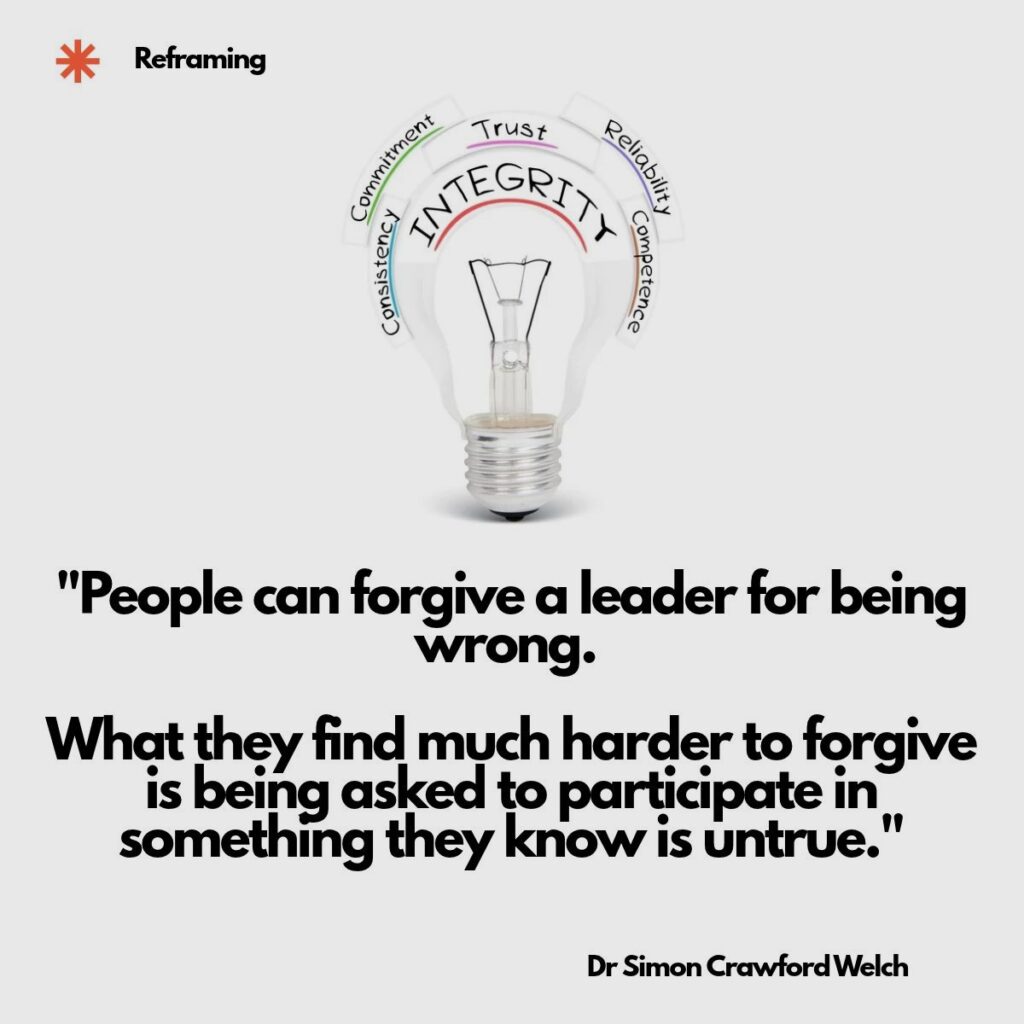
People can forgive a leader for being wrong. What they find much harder to forgive is being asked to participate in something they know is untrue.
The Exhausting Performance of Perfection
Leadership creates powerful incentives to manage appearances. Investors want confidence. Employees want reassurance. Customers want reliability. Boards want evidence that someone understands the situation and has a credible plan.
Those expectations are reasonable. The problem begins when reassurance becomes more important than accuracy.
A leader who believes they must always appear certain gradually loses the freedom to think openly. Questions become threatening because they might expose incomplete understanding. Contrary evidence becomes inconvenient because it challenges the narrative. Admitting a mistake becomes an exercise in reputation management rather than learning.
Over time, the leader becomes trapped inside an image they helped construct.
I have watched executives devote extraordinary energy to explaining why a strategy is working when the evidence suggests otherwise. They are not necessarily dishonest people. Often, they have simply become so invested in their original position that acknowledging reality feels like surrendering authority.
The irony is that their teams usually know.
Employees see the missed targets, the departing customers, the unresolved operational problems, and the persistent gaps between promises and execution. They may not understand every financial implication or strategic constraint, but they know enough to recognize when the official explanation requires considerable imagination.
And every time leadership insists that the situation is better than it appears, credibility diminishes a little further.
Truth Is Not the Same as Emotional Exposure
There is an unfortunate tendency to equate truthful leadership with public vulnerability. Leaders are encouraged to share their struggles, admit their fears, and reveal the person behind the position.
Sometimes that is helpful. But I do not believe authenticity requires executives to turn their organizations into audiences for their emotional lives.
Employees do not need a running commentary on their leader's insecurities. Nor should leaders confuse unfiltered expression with transparency. An executive who shares every passing anxiety may be entirely sincere while creating unnecessary instability for everyone else.
The distinction lies in responsibility.
A leader can acknowledge that revenue is substantially below expectations without spreading panic. They can admit that a decision was wrong without descending into self-criticism. They can explain that the future is uncertain while still providing a credible direction.
Truthful leadership requires the maturity to communicate reality in a form that people can understand and act upon.
That often demands more emotional discipline than projecting confidence. It is easier to offer reassurance than to explain an uncomfortable situation without exaggerating either the danger or the solution.
What Happens When Leaders Admit They Were Wrong
One of the most revealing moments in any organization occurs when a senior leader acknowledges a significant mistake.
People instinctively pay attention because the admission interrupts the normal relationship between authority and accountability.
Consider a CEO who championed a new commercial strategy, invested heavily in its execution, and repeatedly assured the organization that results would follow. Six months later, performance remains disappointing.
There are several available responses. The CEO can blame execution, argue that the strategy needs more time, challenge the quality of the data, or suggest that external conditions made success impossible.
Some of those explanations may contain legitimate elements of truth.
But suppose the CEO instead says, "I believed this was the right direction. We made a substantial investment, and the results have not justified that decision. Some of our assumptions were wrong, and I was responsible for approving them. Here is what we have learned, and here is what we are changing."
That statement does not magically repair the financial damage. It does something equally important for the organization's future: it makes reality discussable.
Managers no longer have to defend a failing approach merely because leadership endorsed it. Employees can raise concerns without appearing disloyal. The organization can redirect resources toward a better answer.
The admission creates movement because it removes the need to protect yesterday's judgment.
Why Truth Creates More Confidence Than Certainty
We frequently mistake certainty for strength.
A leader who speaks decisively, answers questions quickly, and expresses little doubt can appear remarkably competent. Sometimes that confidence is justified. Other times, it reflects a personality more comfortable announcing conclusions than examining assumptions.
The difficulty is that employees eventually learn whether confidence is supported by sound judgment.
When a leader consistently acknowledges what is known, what remains uncertain, and what evidence might change the decision, people develop a more useful form of confidence. They begin to trust the leader's process rather than depending entirely on the leader's predictions.
That distinction matters enormously.
No executive can guarantee that every strategy will succeed. Markets change, customers behave unexpectedly, competitors respond, and talented people make consequential mistakes. What leaders can demonstrate is a willingness to confront evidence, reconsider assumptions, and act responsibly when circumstances change.
Trust does not require a leader who is never mistaken. It requires a leader whose relationship with reality survives being mistaken.
The Cultural Cost of Pretending
The real damage caused by performative perfection extends beyond the leader's individual credibility.
It changes the organization's behavior.
When leaders cannot acknowledge their own mistakes, managers become reluctant to acknowledge theirs. When every executive presentation must communicate confidence, problems are progressively softened as they move upward. When bad news is treated as evidence of weak leadership, people become skilled at managing what leadership hears.
Eventually, the company develops two versions of reality: the one discussed in official meetings and the one employees describe privately.
This is a particularly dangerous condition because intelligent organizations can become exceptionally good at maintaining it. Reports remain polished, explanations become sophisticated, and meetings create the appearance of disciplined management.
Meanwhile, the underlying problems continue.
A culture that cannot tolerate uncomfortable truth will eventually struggle to make sound decisions, regardless of how talented its people are.
Truth Still Requires Judgment
There is, however, a distinction between telling the truth and telling every truth indiscriminately.
Leadership involves confidential information, incomplete decisions, sensitive relationships, and legitimate obligations to employees, investors, and customers. Not every detail can or should be shared with everyone.
A responsible leader understands those boundaries.
The obligation is to avoid creating false impressions. If information cannot be disclosed, say so. If a decision has not been made, acknowledge that. If the evidence is incomplete, explain what remains unknown. If circumstances have changed, tell people rather than hoping they will not notice.
There is no virtue in dressing up uncertainty as certainty simply because uncertainty is uncomfortable to communicate.
Nor is there wisdom in using honesty as an excuse for cruelty. Truth can be delivered with dignity, context, and compassion. In fact, the more difficult the message, the more important those qualities become.
The objective is to help people understand reality accurately enough to respond intelligently.
The Courage to Be Credible
Perhaps the most important shift leaders can make is to stop measuring their effectiveness by how impressive they appear.
That is an exhausting standard, and ultimately an impossible one.
A more useful measure is whether people believe what they say, particularly when the message is difficult. Whether employees feel able to challenge an assumption. Whether mistakes can be acknowledged before they become crises. Whether uncomfortable information travels toward leadership rather than away from it.
Those conditions do not emerge from occasional displays of vulnerability. They develop through repeated behavior, especially when telling the truth carries personal consequences.
I suspect the leaders we remember most positively are rarely those who managed to appear flawless. They are the ones who made us feel that we could deal with difficult realities because they were willing to deal with them too.
They did not need every decision to validate their intelligence or every outcome to protect their reputation.
They were credible.
And credibility, unlike the appearance of perfection, becomes stronger when it is tested.
People do not need leaders who pretend to have everything figured out. They need leaders who are sufficiently secure in themselves to distinguish what they know from what they believe, to recognize when they have been wrong, and to confront circumstances without asking everyone else to maintain an illusion.
Because the moment people stop believing the story, the leader's confidence becomes irrelevant.
What matters then is whether anyone still believes the person telling it.