Quick Reads
QUICK READ — EMOTIONAL INTELLIGENCE
Trust Fatigue: What Happens When Employees Stop Believing Leadership
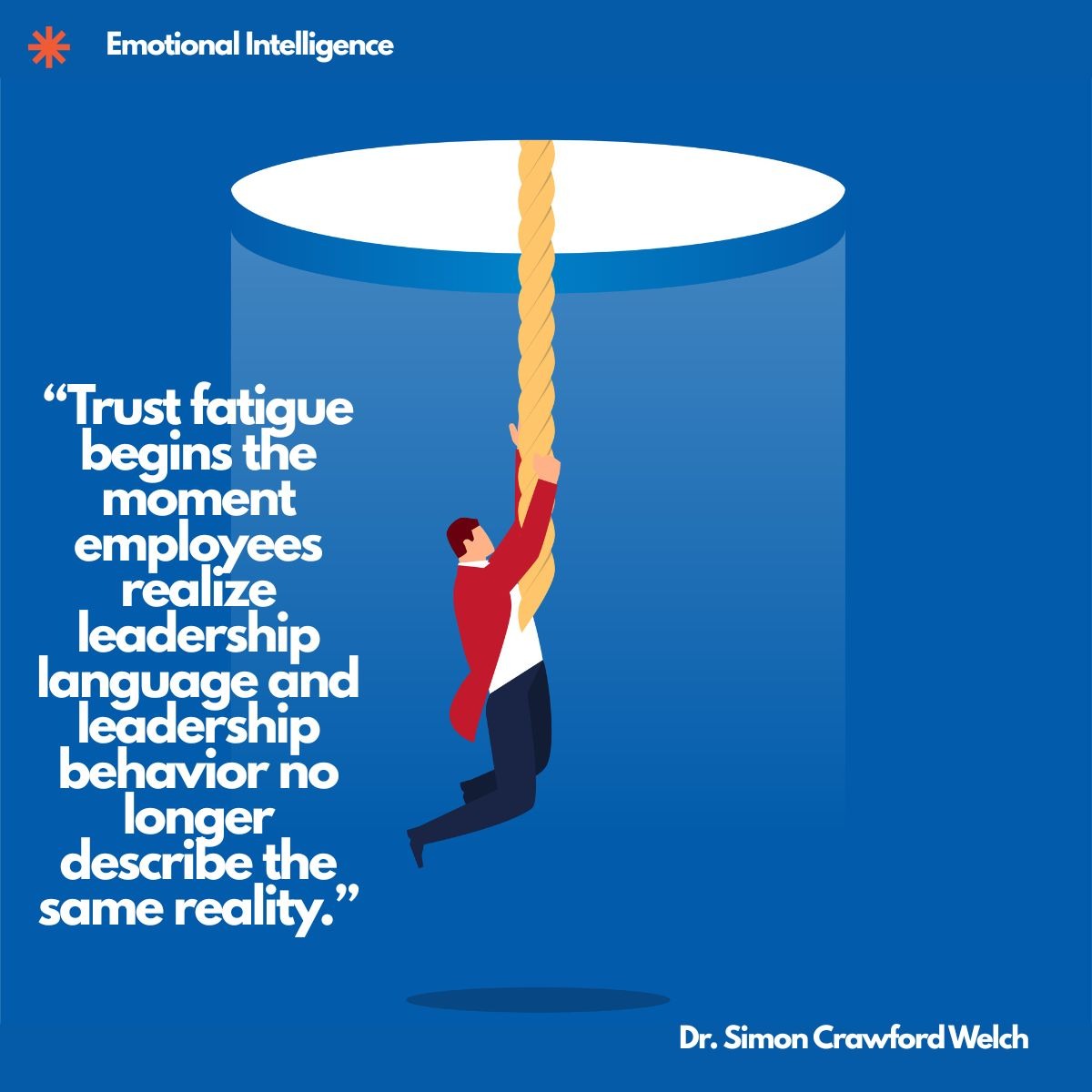
There is a quiet form of organizational burnout that never shows up on a dashboard, an engagement survey, or a quarterly board deck. It does not announce itself dramatically. It arrives slowly, through accumulated disappointments, inconsistencies, half-truths, strategic spin, and promises employees eventually learn not to take seriously. It is trust fatigue.
At first it looks like ordinary disengagement. Productivity softens. Meetings go quiet. Initiative declines. People stop volunteering ideas. Leaders often read it as laziness, entitlement, or cultural drift. Usually it is something more psychologically specific. Employees have simply stopped believing, and once belief goes, almost every other system becomes more expensive to run.
Trust Is an Economic Force, Not a Soft One
Most leaders still treat trust as morally nice but operationally secondary. In reality it is one of the most powerful economic forces inside a business. High trust reduces friction. Decisions move faster, communication gets more honest, collaboration needs less political maneuvering, and people spend less energy protecting themselves and more energy solving problems.
The shift is cognitive as much as cultural. When people feel psychologically unsafe, the brain quietly reallocates energy toward threat detection. Employees become hyper attuned to political risk, status, and reputational protection, which consumes enormous mental bandwidth. In low trust environments people stop asking how to build something great and start asking how to avoid becoming vulnerable. That single change reshapes everything.
Credibility Is Built by Behavior, Not Messaging
Trust fatigue spreads because modern organizations often operate inside permanent contradiction. Companies preach transparency while carefully curating narratives. They celebrate wellbeing while normalizing exhaustion. They promise long term thinking while reacting quarter to quarter. Employees notice these gaps far more than leadership assumes.
One of the great misconceptions of management is that credibility comes mainly from communication skill. It comes from behavioral consistency over time. People are pattern recognition machines. They study who gets promoted, whose behavior gets tolerated, how decisions are actually made, and whether values survive financial pressure. Trust rarely collapses from one dramatic lie. It erodes through accumulated micro inconsistencies until employees stop interpreting messaging literally and start translating everything through skepticism.
Why Your Best People Detach First
Disengaged employees are often not apathetic people. Many were once deeply committed. Trust fatigue tends to hit high performers hardest because they entered the most invested. They believed the vision, cared about the mission, and extended discretionary effort repeatedly. Their eventual withdrawal is not the absence of care. It is the scar tissue left after care was not reciprocated.
Psychologists describe this through learned helplessness. When effort appears repeatedly disconnected from outcome, motivation deteriorates. People stop trying, not because they are incapable, but because they no longer believe agency exists. Watching mediocre performers advance through politics, or accountability applied unevenly depending on rank, teaches that lesson quickly, and it is very hard to unlearn.
The Technology Layer Makes It Worse
Digital communication has increased organizational velocity but reduced emotional texture. Employees now experience leadership primarily through Slack messages, dashboards, performance metrics, and carefully managed updates. Human ambiguity gets flattened into corporate efficiency, and ironically, the more optimized communication becomes, the less believable it often feels.
AI will likely intensify this tension. As leadership communication becomes increasingly AI assisted, polished language becomes easier to produce while genuine trust becomes harder to sustain. Employees are already learning to distinguish authentic conviction from manufactured corporate empathy. Trust cannot be automated, because it is relational rather than informational, and relationships deteriorate when people feel managed rather than understood.
The Hidden Organizational Costs
Trust fatigue creates costs that rarely appear directly on a financial statement. Innovation slows because employees stop risking social exposure. Collaboration weakens because political caution replaces intellectual honesty. Decision quality deteriorates because people withhold dissenting opinions. Managers then spend increasing energy policing behavior that trust previously regulated for free.
Organizations usually respond by adding more process, more oversight, more approvals, and more measurement. Ironically, those mechanisms often deepen the original problem, because the less employees feel trusted, the less trustworthy they tend to behave. Surveillance cultures create performative cultures, and people begin optimizing for optics rather than outcomes. This is why trust is not merely cultural. It is infrastructural, and without it, scale becomes extraordinarily expensive.
The Leadership Question Few Want to Ask
The uncomfortable reality is that trust fatigue often says more about leadership psychology than employee psychology. Many leaders genuinely want trust while struggling to tolerate the vulnerability trust requires. Real trust demands consistency under pressure, the willingness to admit uncertainty, and the courage to confront contradictions honestly even when short term optics suffer. That is difficult in cultures obsessed with confidence and certainty, and so, in trying to preserve confidence externally, many leaders quietly destroy belief internally.
Trust Is Finite
The most dangerous assumption in business is that trust regenerates automatically over time. It does not. It behaves like emotional capital. It compounds slowly through consistency and drains rapidly through contradiction. Once depleted, employees do not simply reset because leadership launches a new initiative or rebrands its values.
People remember patterns. Eventually they stop asking whether leadership is smart, visionary, or ambitious, and start asking something far simpler: do I actually believe you anymore? Once that question takes hold deeply enough, everything else, from innovation to retention, becomes harder to sustain.
QUICK READ — PERSONAL DEVELOPMENT
The Character Economy: Why Trust Is Becoming More Valuable Than Talent
For most of modern business history, talent sat at the top of the hierarchy. Companies competed aggressively for intelligence, technical ability, creativity, and raw execution. The assumption was simple and rarely questioned. The smartest people would win, the most skilled operators would dominate, and the most ambitious organizations would outcompete everyone else.
That logic shaped hiring systems, compensation structures, and leadership cultures. But something deeper has begun shifting beneath the surface of work. As technology accelerates and information becomes abundant, talent itself is being commoditized. Expertise is more accessible, AI can replicate large portions of analysis, writing, and strategy in seconds, and even creativity feels less scarce. In the middle of that transformation, a different form of value is quietly rising: character.
The Collapse of Information Scarcity
One reason character is becoming more valuable is that information no longer creates the moat it once did. Historically, expertise carried power because access was limited. Specialists held knowledge others could not easily obtain, and elite institutions functioned partly as trust filters because verifying competence independently was difficult.
That world is fading rapidly. Knowledge now moves almost frictionlessly. This does not mean talent stops mattering; exceptional ability always will. But the relative scarcity equation is changing. When intelligence becomes abundant, people begin searching for the qualities technology cannot easily replicate: reliability, judgment, moral courage, emotional steadiness, and self awareness. Ironically, the more technologically advanced society becomes, the more valuable deeply human traits become.
Why Talent Alone Is No Longer Enough
Many organizations have learned this lesson painfully. Some of the most destructive people inside companies are not incompetent. They are highly talented individuals with low relational trustworthiness. Brilliant executives who create political instability. High producing salespeople who erode culture. Visionary founders who cannot regulate emotionally.
Talent can create growth. Character determines whether that growth becomes sustainable. Research from Deloitte, Edelman, and PwC consistently shows trust shaping retention, customer loyalty, and organizational resilience. That reflects something larger than changing workplace preferences. It reflects a civilization experiencing institutional trust erosion at scale, and when trust in large systems declines, individual character matters more, not less.
The Rise of the Trust Premium
One of the most overlooked economic forces of the next decade may be what could be called the trust premium. People and organizations perceived as deeply trustworthy will increasingly command disproportionate opportunity, loyalty, influence, and leverage, not because they are necessarily the most brilliant, but because uncertainty makes trust extraordinarily valuable.
This is already happening quietly. Consumers pay more for brands they believe operate transparently. Employees stay with leaders they trust emotionally even when competitors offer more money. Investors back founders whose integrity lowers perceived risk. Trust reduces friction, and friction is one of the great hidden taxes inside modern systems. High trust organizations move faster because fewer defensive mechanisms are required, while low trust ones grow expensive, multiplying meetings, approvals, and oversight to compensate for relational instability.
AI and the Authenticity Filter
Artificial intelligence may accelerate the value of character even further, because AI increases the volume of synthetic, polished communication flooding daily life. As that happens, humans become more sensitive to authenticity signals. People begin asking not merely whether information is accurate, but whether the source itself feels credible, grounded, and humanly trustworthy.
This creates a fascinating paradox. Technology is making performance simulation easier than ever, yet that very ease increases skepticism toward surface level competence. When everyone can sound smart, trust shifts elsewhere, toward emotional congruence and behavioral consistency over time. Character becomes the filter through which capability gets interpreted.
Character as a Strategic Asset
Historically, character was discussed as a moral issue. Increasingly it is becoming a strategic one. Organizations built around trust tend to demonstrate greater resilience during volatility, because trust stabilizes systems under stress. Employees communicate more openly during crises, customers extend more grace during failures, and leaders retain credibility longer during uncertainty.
Character also shapes adaptability. Low character environments produce defensive behavior, where people hide mistakes, distort information, and protect status. High character cultures create intellectual honesty because people feel safe confronting reality directly. That matters enormously in an age of rapid change, because the future likely belongs not merely to the most intelligent organizations, but to the most reality based ones, and people do not tell the truth where truth feels unsafe.
The Deeper Shift in How We Define Value
Beneath all of this sits a larger transformation in how society defines value itself. For decades, modern culture celebrated optimization above almost everything: productivity, scale, personal branding, and relentless self presentation. But optimization cultures often create emotional exhaustion, because they quietly reward performative identity over authenticity. Eventually trust erodes because everyone senses the performance layer underneath the interaction. The character economy is partly a backlash against that dynamic, a recognition that complex societies cannot function indefinitely without trust.
The New Scarcity
Every economic era eventually reveals its true scarcity. During the industrial age it centered on manufacturing capacity. During the information age it centered on knowledge. But in an age where intelligence is increasingly augmented, automated, and abundant, a different scarcity emerges: people you can genuinely trust. Not performatively, not selectively, not only when conditions are easy, but consistently.
A brilliant employee who cannot be trusted becomes expensive. A gifted leader without integrity becomes destabilizing. A high performing culture without emotional credibility eventually burns itself out from the inside. Character is no longer merely a moral conversation. In a world drowning in information, optimization, and synthetic expertise, it is quietly becoming an economic one.
QUICK READ — LEADERSHIP
The Trust Crisis Inside Modern Leadership
There is a strange contradiction unfolding inside modern organizations. Leaders today communicate more than ever before. Employees receive constant updates, mission statements, town halls, culture decks, podcasts, strategy sessions, and carefully crafted internal memos. Transparency has become a corporate virtue and visibility is treated as a leadership competency.
And yet, despite all this communication, trust appears to be deteriorating almost everywhere. Employees distrust executives. Consumers distrust corporations. Even within leadership teams, suspicion often quietly replaces alignment. The modern workplace has become informationally dense but relationally fragile, and that distinction matters, because leadership was never fundamentally an information problem. It was always a trust problem.
The Collapse of Inherited Credibility
People do not follow leaders merely because they hold authority, intelligence, or vision. They follow because they believe. They believe the leader sees reality clearly, that incentives are reasonably aligned with their own, that difficult decisions are made with integrity rather than pure self preservation, and that sacrifice will not be endlessly exploited. Once belief fractures deeply enough, leadership itself becomes unstable, regardless of titles or org charts.
Historically, institutions benefited from inherited credibility. Titles carried weight automatically and executive authority generated trust by default. That baseline has weakened dramatically. Today employees question compensation structures, layoff decisions, culture messaging, and executive incentives. The modern workforce increasingly evaluates leadership through skepticism first rather than trust first. Authority is no longer assumed; it must be continuously earned.
Performance Theater
One reason trust has deteriorated is that modern leadership culture increasingly rewards performance over congruence. Executives are trained to project certainty constantly. Confidence becomes currency. Social media and digital communication have transformed leadership into a partly performative profession, where leaders manage perception almost as aggressively as they manage operations.
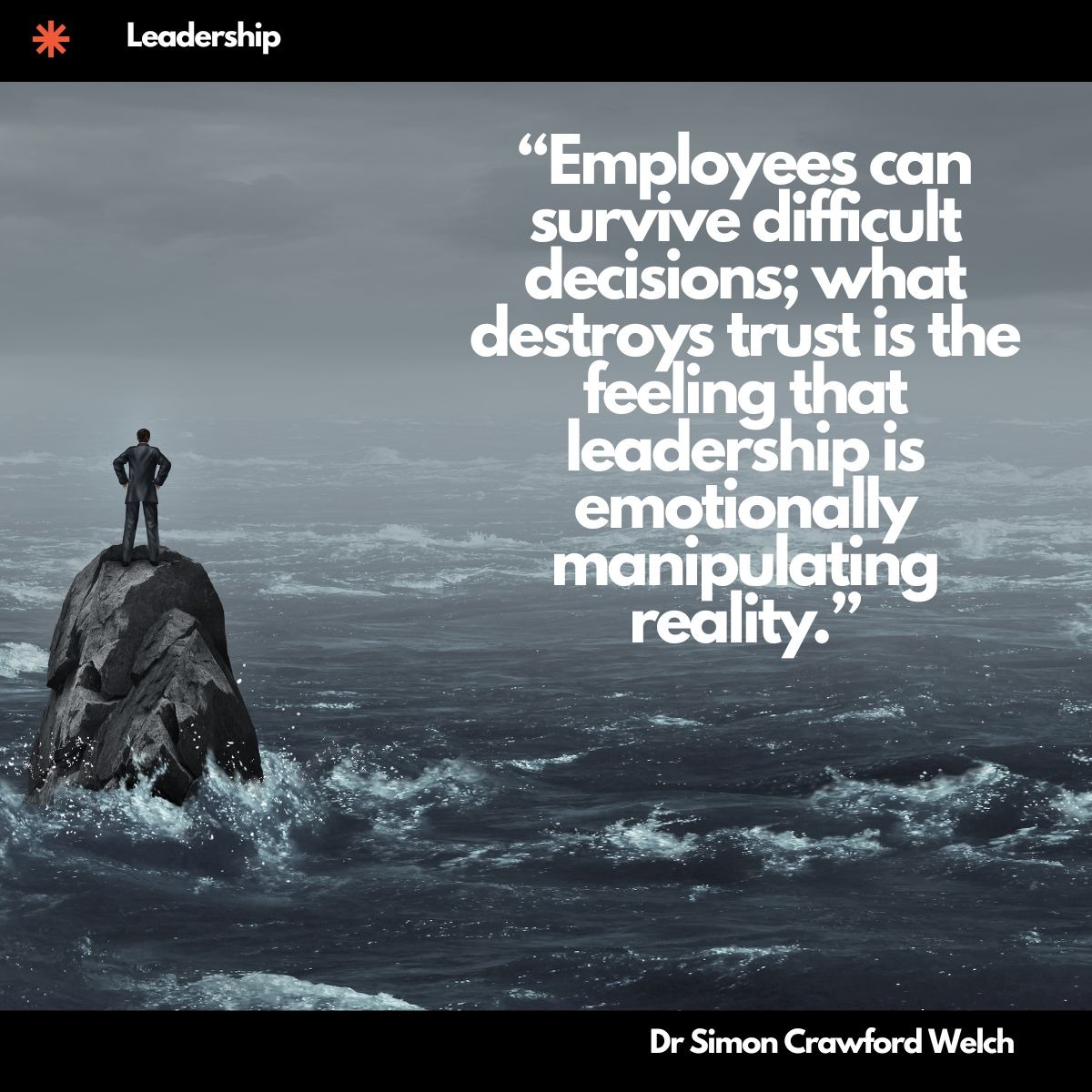
The result is that many organizations now operate inside carefully curated emotional realities. Leaders speak in polished language about authenticity while strategically filtering vulnerability. They promote transparency while withholding critical context. Employees notice these contradictions far more than leadership teams realize. The issue is rarely that leaders make difficult decisions; people understand complexity and economic pressure. What destroys trust is perceived dishonesty around those realities, hard truth wrapped inside emotional manipulation.
How Cynicism Takes Hold
One of the most dangerous outcomes of leadership distrust is organizational cynicism, which is often misunderstood as simple negativity. In reality, cynicism is usually disappointed belief. Most cynical employees were once highly engaged and emotionally invested. They believed the rhetoric, trusted the mission, and extended discretionary energy because they assumed reciprocity existed.
Over time, repeated inconsistencies changed their posture. Promises were quietly abandoned. Accountability became selective. Cultural values disappeared under pressure. Eventually employees stop interpreting leadership communication literally. Meetings become performative, culture language becomes symbolic, and people nod publicly while disengaging privately. At that point organizations may still retain compliance, but belief itself begins collapsing.
Why Trust Matters More in Complex Systems
The importance of trust increases dramatically as organizations grow more complex. In simple systems, control can compensate for low trust temporarily through oversight and rigid rules. But modern organizations operate at speeds and scales where excessive control becomes impossible. Innovation requires psychological safety, adaptability requires intellectual honesty, and fast moving environments require decentralized decisions.
None of those things function well in low trust cultures. When trust deteriorates, organizations compensate through bureaucracy: more approvals, more reporting, more oversight layers. Ironically, these mechanisms often worsen the original problem because they communicate institutional suspicion back to employees. Low trust systems become operationally expensive, and without trust, scale becomes fragile.
The Leadership Contradiction
Perhaps the most uncomfortable part of the trust crisis is that many leaders genuinely want trust while simultaneously behaving in ways that quietly undermine it. This happens because real trust requires psychological conditions many executives struggle to tolerate. It demands consistency under pressure, accountability applied upward as well as downward, and a willingness to sacrifice short term optics for long term credibility.
Those behaviors are difficult inside environments driven by quarterly expectations, investor scrutiny, and constant performance signaling. As a result, organizations often drift toward impression management rather than trust building. Communication gets optimized for morale preservation rather than truth, difficult realities get softened excessively, and vulnerability becomes curated rather than authentic. Employees feel this instinctively, and they begin analyzing communication politically rather than relationally.
The Rise of Transactional Work
One of the clearest signs of the trust crisis is the growing transactionalization of work. Many employees no longer view organizations as relational communities but as temporary economic arrangements, and younger generations in particular approach work with protective caution. Leaders often interpret this as entitlement or a lack of commitment. In reality, much of it reflects adaptive skepticism, a rational response to environments where long term reciprocity has felt uncertain. People do not willingly become vulnerable inside systems they fundamentally distrust, and trust requires exactly that vulnerability to take root.
Believability as the Rarest Capital
Artificial intelligence may intensify this crisis further. As AI assisted communication becomes common, internal messaging will sound more articulate and emotionally calibrated, yet this may deepen distrust rather than resolve it. Humans are remarkably intuitive at detecting emotional authenticity, and the more optimized leadership messaging becomes, the more people may crave signs of honesty, uncertainty, and psychological realism. Trust emerges relationally, through consistency and congruence over time, and it cannot be automated.
Perhaps the most uncomfortable part is that many leadership teams underestimate their own role in creating distrust. Employees stop listening primarily to what leadership says and start watching what leadership protects, because what leaders protect reveals what they truly value. In an era overflowing with communication, branding, and performance signaling, the rarest form of leadership capital left may not be charisma, intelligence, or even vision. It is believability.